The Six Factor Consistent Growth Strategy
Introduction
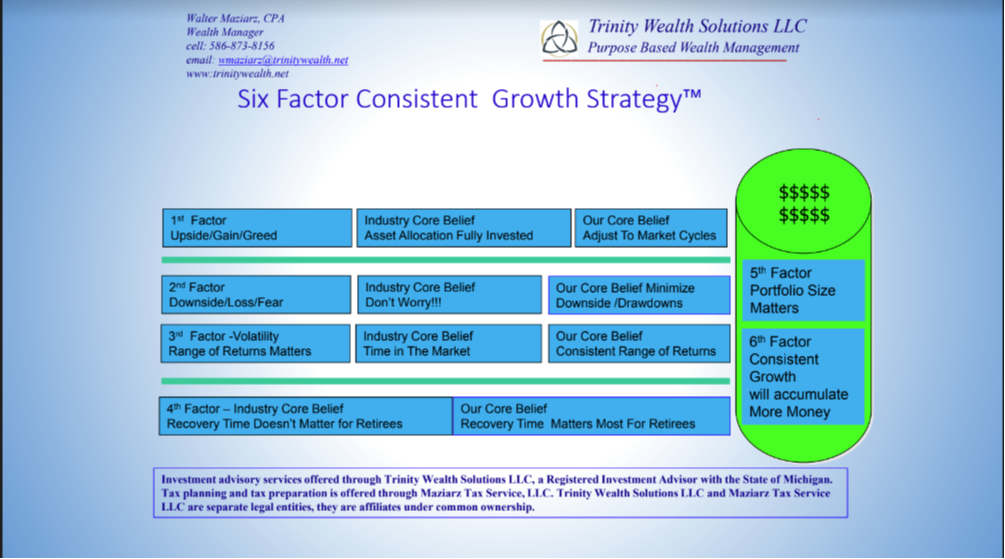
Trinity Wealth is dedicated to providing strategic and tactical investment management tailored to the unique objectives of each client. A cornerstone of our approach is the Six Factor Consistent Growth Strategy, which ensures that our clients not only achieve their financial goals but do so with a methodical and risk-managed approach. This strategy is built on six fundamental factors that address both the potential upsides and the inherent risks of stock market investment.
In the dynamic world of investing, having a consistent growth strategy is essential. It not only helps in navigating the volatility of the stock market but also in capitalizing on opportunities for maximum returns. Trinity Wealth's Six Factor Consistent Growth Strategy is designed to provide a balanced approach, focusing on both growth and risk management. Each factor plays a crucial role in building a robust investment portfolio that aims to increase the probability of outperforming the market while minimizing stock market risk.
1st Factor – Upside/Gain Greed
The first factor focuses on the core industry and investment advisor belief, is to be fully invested in the stock market during bull and bear market cycles, the Buy and Hold investment strategy.
At Trinity Wealth, we do not believe in a Buy and Hold strategy or as we call it Buy and Hope Strategy. Our approach is grounded on technical analysis of stock market sectors, by identifying one or two sectors/asset classes that may provide the greatest probability of higher returns and greater accumulation during bull and bear markets.
Our strategy involves a combination of growth-oriented and defensive investments, such as ETFs with high growth potential, and tactical asset allocation. For instance, during periods of market rally, our tactical asset allocation allows us to capitalize on growth opportunities effectively. We constantly monitor the market for emerging trends and adjust our portfolios accordingly to maximize gains and minimize market losses. This proactive approach may increase the probability that our clients are well-positioned to benefit from favorable and unfavorable market conditions.
2nd Factor – Downside/Drawdown Capture/Loss Fear
While capturing gains is essential, equally important is the management of downside risks. The fear of loss can often paralyze investors, leading to suboptimal decisions. Our approach involves rigorous risk assessment and the implementation of safeguards to minimize drawdowns. By doing so, we may protect our clients' portfolios from severe market downturns, thus preserving capital and enabling quicker recovery during subsequent market rebounds.
Trinity Wealth employs various strategies to manage downside risks. These include Stop Loss Orders inverse ETF’s and during severe market corrections investing in Short Term US Treasury Bills. Our investment team continuously monitors market conditions and adjusts the portfolios to mitigate potential losses.
The impact of managing downside risk on investor confidence cannot be overstated. By minimizing drawdowns, we provide our clients with peace of mind, knowing that their investments are safeguarded against significant losses. This stability encourages long-term investment, allowing clients to remain committed to their financial goals even during turbulent market phases.
3rd Factor - Volatility Range of Returns
Volatility is a natural characteristic of financial markets. The industry often reassures investors that markets will recover over time and not to worry but at Trinity Wealth, we believe in actively managing volatility. By focusing on minimizing downside volatility, we provide our clients with a smoother investment experience. This approach not only may protect against losses but also helps in maintaining steady growth, which is crucial for long-term financial planning.
Trinity Wealth's approach to managing volatility involves a combination of strategic asset allocation and tactical adjustments based on market conditions.
The benefits of minimizing downside volatility for investors are manifold. By reducing the amplitude of negative returns, we help preserve capital and enhance the overall stability of the portfolio. This stability is particularly important for investors with lower risk tolerance or those approaching retirement, as it ensures that their investments are less susceptible to drastic downturns. Moreover, a less volatile portfolio can improve investor confidence, encouraging them to stay invested and reap the benefits of long-term growth.
4th Factor - Recovery Timeframe Matters
The timeframe within which a portfolio recovers from losses is a critical aspect of investment strategy especially in retirement years. By managing the probability to minimize downside capture, we enhance the likelihood of a quicker recovery. This means that our clients can regain lost ground faster and continue to build wealth without prolonged interruptions. Historical data shows that portfolios with managed downside risk tend to outperform in the long run due to their resilience during market downturns.
Minimizing the downside capture directly influences the recovery timeframe. For example, a portfolio that experiences a 10% loss will need an 11% gain to recover, while a portfolio with a 50% loss will need a 100% gain to return to its original value. By reducing the extent of losses, we make it easier and quicker for portfolios to bounce back. This principle is particularly crucial during market corrections and bear markets, where significant losses can take years to recover if not managed properly.
At Trinity Wealth, we employ a disciplined approach to manage downside risk, including stop-loss orders, rebalancing, and tactical shifts in asset allocation. By proactively managing risks, we aim to reduce the severity of downturns and enhance the overall recovery process. This approach not only helps in preserving capital but also allows clients to stay on track with their long-term financial goals.
5th Factor - Portfolio Size Matters
The impact of losses is significantly magnified in larger portfolios. A 50% loss on a $1,000,000 portfolio results in a $500,000 loss, whereas the same percentage loss on a $100,000 portfolio results in a $50,000 loss. Therefore, it is imperative to implement robust risk management strategies for larger portfolios. At Trinity Wealth, we tailor our investment strategies to account for the size of the portfolio, ensuring that the impact of market volatility is minimized.
Managing the probability to minimize downside capture becomes increasingly important as the portfolio size grows. Larger portfolios often have more complex asset allocations and require sophisticated risk management techniques to protect against significant losses. We employ advanced portfolio management strategies, such as stress testing and scenario analysis, to identify potential risks and mitigate their impact on larger portfolios.
Additionally, we recognize that larger portfolios often represent a substantial portion of an individual's or institution's net worth. As such, the psychological impact of losses can be more pronounced, leading to emotional decision-making and potential deviation from long-term investment plans. By implementing strategies to manage downside risk, we help our clients maintain their investment discipline and confidence, even during volatile market periods.
6th Factor – Accumulation
Albert Einstein famously referred to compound interest as the eighth wonder of the world. By minimizing downside capture, we enhance the probability of accumulating more wealth over time. The power of compounding can significantly amplify the growth of an investment portfolio. Our strategies are designed to maximize this effect, ensuring that our clients benefit from exponential growth in their investments.
Compound interest works by generating earnings on both the initial principal and the accumulated interest from previous periods. When portfolio drawdowns are minimized, the base amount for compounding remains larger, leading to greater overall growth. For example, avoiding a significant loss allows the portfolio to continue compounding on a higher base, accelerating wealth accumulation.
Trinity Wealth focuses on long-term investment strategies that leverage the power of compounding. By minimizing downside risk and maintaining steady growth, we create an environment where compound interest can work its magic. This approach is particularly beneficial for younger investors or those with long investment horizons, as it maximizes the potential for wealth accumulation over time.
Conclusion
The Six Factor Consistent Growth Strategy is a comprehensive approach that addresses both the potential gains and risks of stock market investment. By focusing on these six factors, Trinity Wealth provides a balanced and strategic pathway to financial growth. Each factor plays a crucial role in building a robust investment portfolio that aims to outperform the market while minimizing risks.
In conclusion, Trinity Wealth's Six Factor Consistent Growth Strategy is designed to help clients achieve their financial goals with confidence. By managing downside risks, optimizing upside gains, and leveraging the power of compound interest, we provide a well-rounded investment approach. We invite potential clients to explore this strategy further and see how it can be tailored to meet their unique investment objectives.